



Associate Professor
Eucharia Donnery
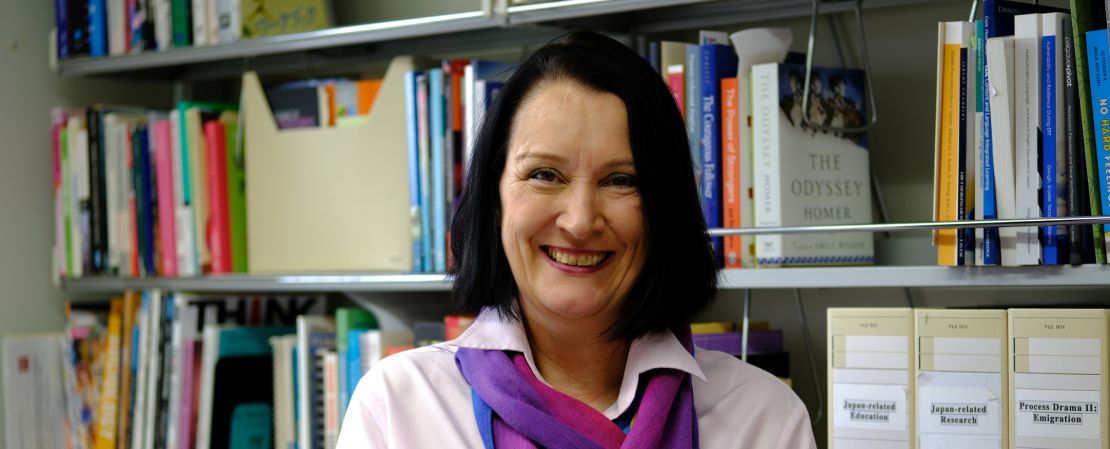
Profile
| Specialized Field | Process Drama in Second Language Acquisition, Drama in Education (DiE), drama-based pedagogy, AI and Computer Assisted Language Learning (CALL), gender studies, colonial studies and feminist discourses, Intercultural Communicative Competence (ICC), sociology, English literature studies. |
|---|---|
| Research theme | Second Language in Language Acquisition (SLA); Process Drama (PD) in SLA; Intercultural Communicative Competence (ICC); Content and Language Integrated Learning (CLIL); Computer Assisted Language Learning (CALL); Drama in Education (DiE); Reflective Practice. |
| Laboratory Information | Global Square AW908 |
| Subjects in charge | Principles of Education, Academic Writing |
| Main career, work history, and academic background | ACADEMIC POSITIONS |
| Degrees Obtained | EDUCATION |
| Message | Welcome to the Faculty of International Liberal Arts (FILA) at Soka University. |
| Specialized Field | Process Drama (PD) in Second Language Acquisition; Intercultural Communicative Competence (ICC); Computer Assisted Language Learning (CALL) |
|---|---|
| Research theme | Second Language in Language Acquisition (SLA); Process Drama (PD) in SLA; Intercultural Communicative Competence (ICC); Content and Language Integrated Learning (CLIL); Computer Assisted Language Learning (CALL); Drama in Education (DiE); Reflective Practice |
| research summary | My research interests encompass a diverse range of disciplines, paving the way for collaboration and development between researchers, teachers and students in academia. These disciplines include: drama-based pedagogy in Second Language Acquisition (SLA), Content Language Integrated Learning (CLIL), Intercultural Communicative Competence (ICC), Computer Assisted Language Learning (CALL), as well as the humanistic approach to education through the lens of psychology. |
| Research and Education Policy | Both Irish and Japanese cultures place enormous value on the virtue of lifelong education, whereby learning is from womb to tomb. My goal and teaching aim is to help bridge the gap between “study” in the form of language as code and that of “learning,” whereby students are encouraged to think of language in terms of meaningful exchange. This teaching philosophy is based on both the theory of my PhD research and its practical application to the classroom environment. It centers on three key beliefs; utilizing students existing knowledge for use in the classroom, fostering learner-centeredness and teacher responsibility for the facilitation of learning to occur. In terms of course creation and development, the most important place to start from is the needs of the students. Students attend university with a wealth of experiences; some that are unique to the individual student while more are from the shared knowledge of cultural identity. |
| Main career, work history, and academic background | ACADEMIC POSITIONS Shonan Institute of Technology (2014-2021) Sophia University (2010-2014) Kwansei Gakuin University (2008-2010) Hiroshima International Academic University (2007-2008) Ritsumeikan Asia Pacific University (2004-2007) |
| Degrees Obtained | EDUCATION M.A. in Drama and Theatre Studies (1998) |
| Message | Previous research has indicated to me that learner-centeredness and active research play an important role in the Japanese elementary school system. Students are encouraged to seek out their own answers and to contribute to the class learning experience. In this way, participation is a responsibility rather than a choice. This is a very valuable attribute and can easily be adjusted to the university English learning classroom. Even the most reluctant learner can respond positively to the learner-centered university English class. For my interview to enter the JET program some time ago, I was asked what my philosophy would be in the case of students sleeping in class. When I realized that this question was not the joke that I initially thought, I responded that it is the teacher’s responsibility to provide a classroom environment that maximizes interest for the students. Teaching can be both career and, when done well, a performative art which has the potential to elevate learning for all. |