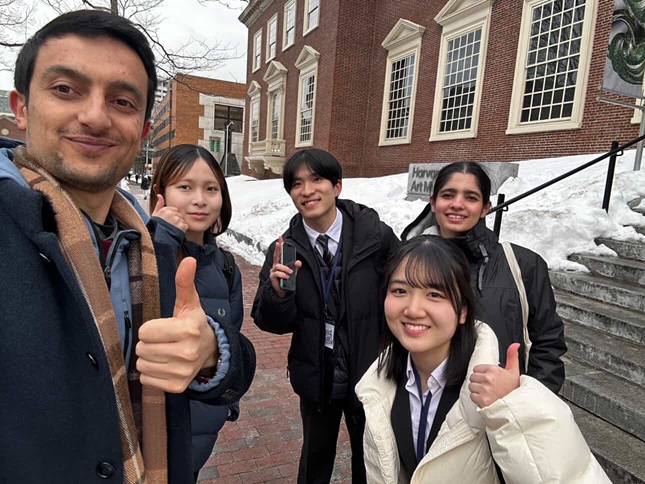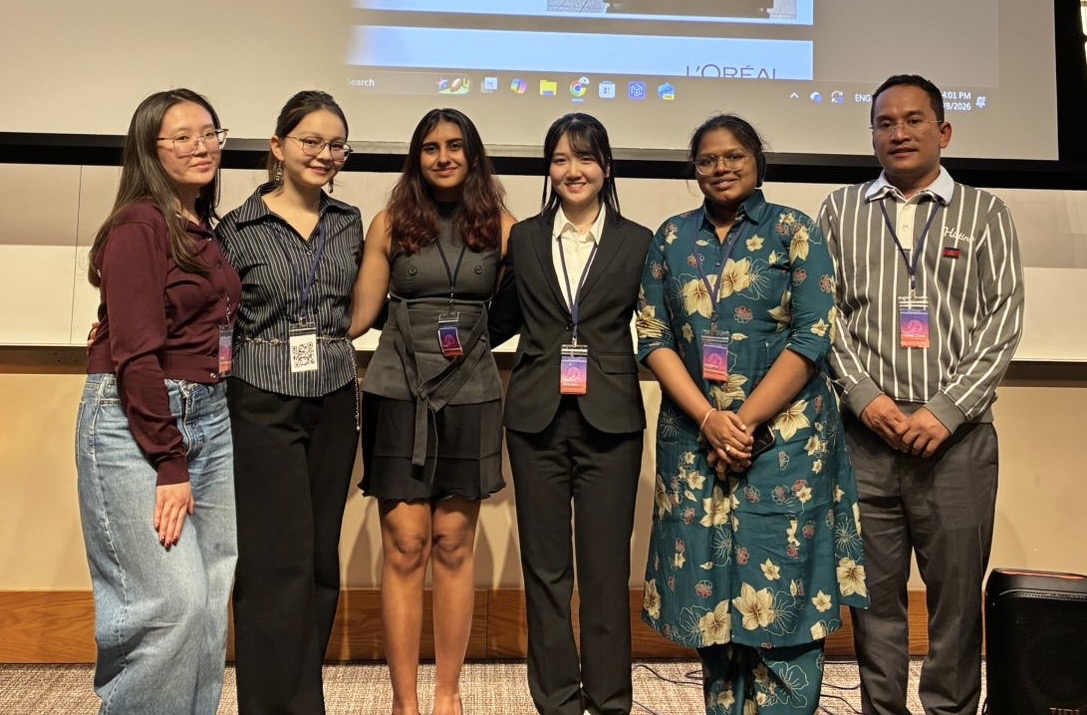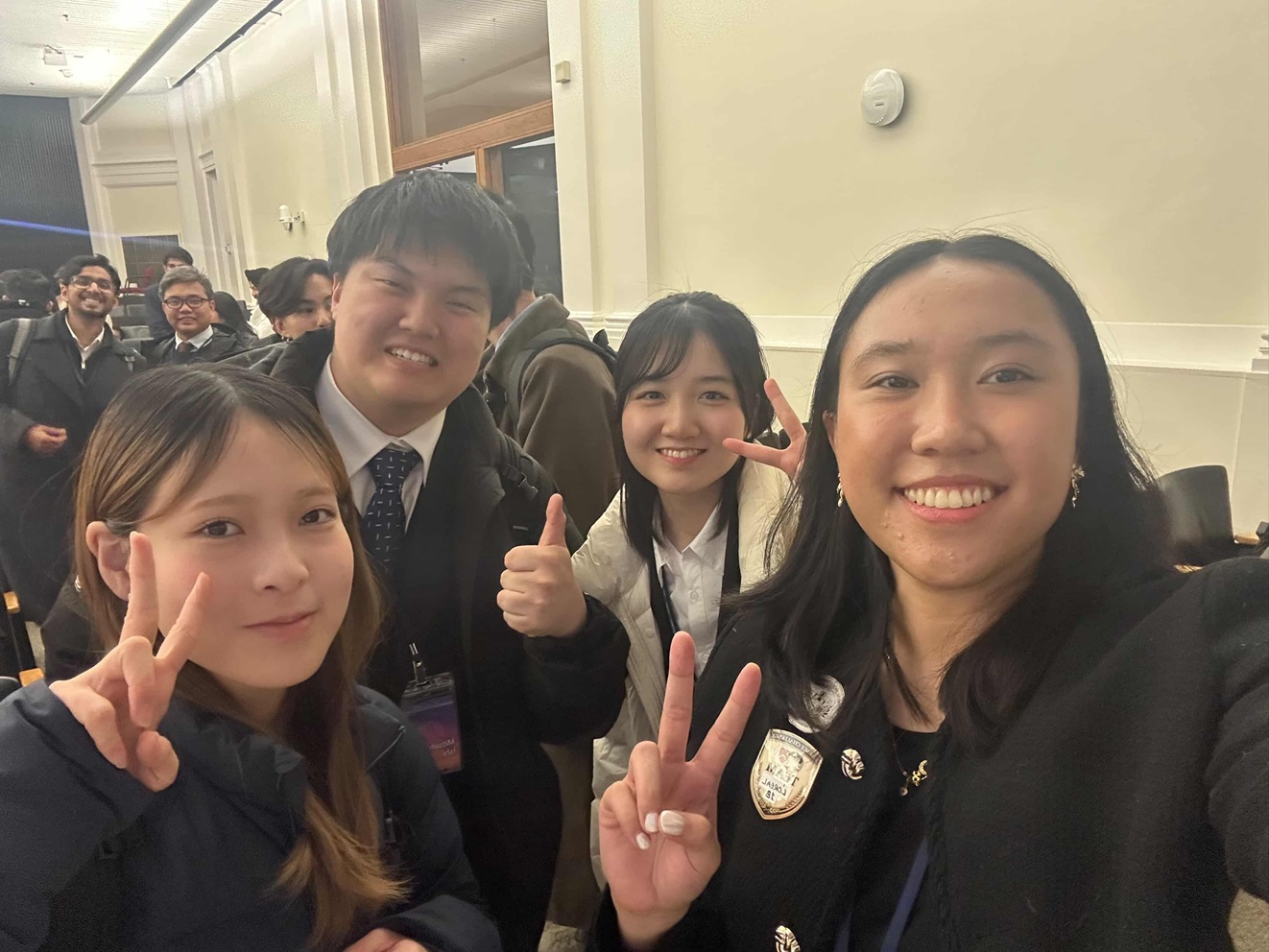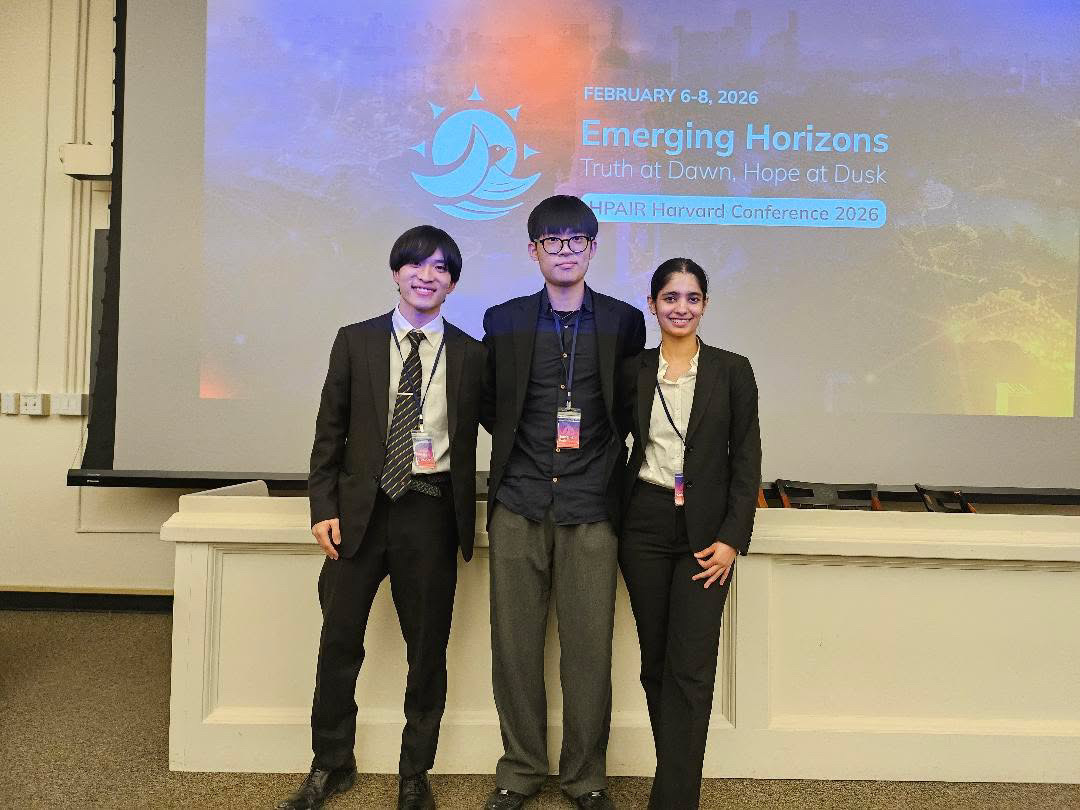
Three students from our university participated in HPAIR, an international student conference hosted by Harvard University.

From left to right in the center are Mika Kobayashi (4th year, Faculty of Economics), Koichi Mori (4th year, Faculty of Economics), and Yoshie Kawano (4th year, Faculty of Law).

From Friday, February 6 to Sunday, February 8, 2026, three participants from our university—Yoshie Kono (4th year, Faculty of Law), Mika Kobayashi (4th year, Faculty of Economics), and Koichi Mori (4th year, Faculty of Economics)—participated in the international student conference "HPAIR" held at Harvard University in the United States.

This conference brings together students, young leaders, and experts from around the world to discuss and collaborate on global challenges.
This conference was themed "Emerging Horizons — "Truth at Dawn, Hope at Dusk," and not only pointed out the social issues facing them, but also focused on constructive perspectives on "what we can build with our own hands" for the future.

Each session at the conference featured a wide range of topics, including the coexistence of AI and technology, geopolitics and international relations, and hope in uncertain times.
The three participants engaged in in-depth discussions with participants and experts from around the world, each focusing on their respective areas of interest. Through discussions, it became clear that increasingly complex International Affairs Department issues cannot be solved in a single field and require a combination of multiple perspectives—technology, policy, society, and ethics. Furthermore, even amid major power conflicts and uncertain situations, cross-border cooperation and the initiative of each young person to take small actions can drive future change. We gained a deep and common lesson.

Participation from students included the following feedback:
■ Yoshie Kono (4th year, Faculty of Law / 3rd year at the time of participation)
While studying abroad in Canada, I learned about international issues, which led me to consider "what I should do from now on," and I decided to participate because I wanted to broaden my perspective by discussing with students and experts from around the world. Feeling firsthand the high level of outstanding participants aiming to become future leaders, being able to ask questions in front of a large group and actively participate in group work gave me great confidence.
Although it was a short time, meeting peers from diverse backgrounds, learning together, and deepening friendships is a great asset. Proud to have participated as a founding student at Harvard University, where founder Professor Daisaku Ikeda gave lectures twice, we aim to become individuals who can continue to challenge the world.

■ Mika Kobayashi (4th year, Faculty of Economics / 3rd year at the time of participation)
Through speaker sessions led by instructors active in various fields, our understanding of the challenges facing modern society deepened further. We learned that in uncertain times, it is crucial to maintain hope, and that cross-border cooperation and proactive youth action are essential for solving complex international issues.
In group work, we discussed and presented on "How young people can increase interest in using AI to realize their ideas." Although there were times when opinions clashed due to the diverse cultural backgrounds of the members, by continuing dialogue while respecting each other's perspectives, we gained new perspectives and became a valuable experience that greatly broadened our own horizons.

■ Koichi Mori (4th year, Faculty of Economics / 3rd year at the time of participation)
While studying geopolitics and international relations at an American university, I became interested in the impact of great power rivalries on small countries. At the conference, I listened to lectures by experts who have promoted Mongolia's denuclearization policy, and I strongly felt the importance of small countries sandwiched between major powers to proactively raise their voices in the international community. Students learned the need to continue thinking independently about international issues.
We were also greatly inspired by participants from various countries who are strongly aware of their own social issues and take action. During the group work, we exchanged opinions on disaster response and poverty projects in the Philippines that I worked on during my first year at the GCP (Global Citizenship Program), and it was a valuable opportunity to deepen discussions while sharing my own experiences and field research experiences with the world.

【Related Links】
Share