

Learning Russian and building a bridge of peace in these difficult times
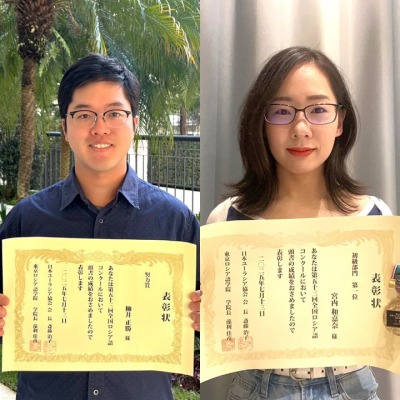
Masakatsu Yanai Faculty of Letters Department of Human Studies 3 years
Miyauchi Wakana Faculty of International Liberal Arts Department of International Liberal Arts 3 years
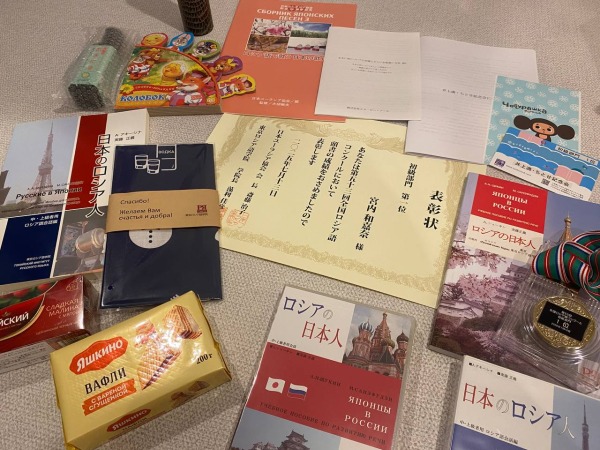
At the 53rd National Russian Language Competition, where Russian language learners compete in speeches, Kazukana Miyauchi (Faculty of International Liberal Arts 3rd year) won first place in the beginner category, and Masakatsu Yanai (Faculty of Letters 3rd year) won the Effort Award in the general category. In response to the increasingly complex international situation, the University will launch the "Russian Intensive Course" and "Chinese Intensive Course" as new language education programs for undergraduate students from April 2026. We asked the two people, who aspire to connect Japan and Russians by language, about their hardships in participating in the competition, the joy of winning awards, and their passion for the Russian language.
What first sparked your interest in Russian?
Yanai: When I was in elementary school, I heard the national anthem of the Soviet Union and was captivated by the sound of the Russian language and the beauty of its melody, which led me to start studying Russian history. From there, my interest in Russia and the Russian language grew, and I learned the basics of Russian while at Soka High School, before beginning to study it in earnest in university.
It all started when I learned that
Miyauchi 's grandfather was from Sakhalin. I had never met him and only found out about it before I entered university, but I wanted to see the town where he was born and raised with my own eyes someday, so I decided to learn Russian at university.
How do you study Russian at university?
Yanai: In my first year, I took four to five Russian classes a week, studying for 12 to 13 hours. I also belonged to a club called the Russian Studies Club, and after school I learned about Russia while being inspired by my fellow students who were also studying Russian. We occasionally had a "cooking club" where we had fun making Russian dishes like porridge called kasha and piroshki, and Miyauchi was also a club member.
Miyauchi: That's right. Although the club is on hiatus this year, I have had constant opportunities to interact with unique Russian language learners and teachers through club activities, which has helped me maintain my motivation to study. The main events of the Russian Studies Club are the Soka University Festival and the speech contest that we host every year, and one of the biggest attractions of the speech contest is that I get to interact with contestants from outside the university.
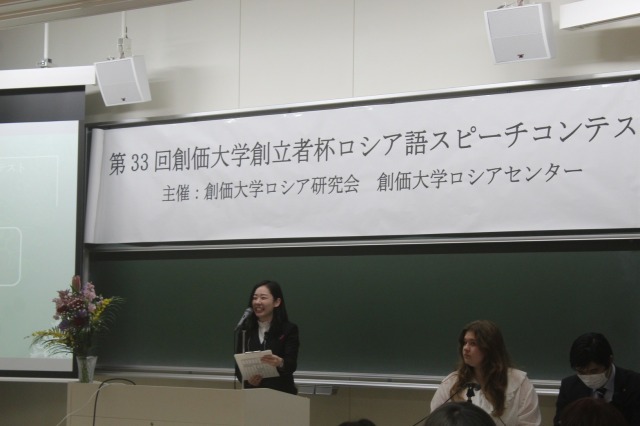
Why did you decide to enter the National Russian Language Competition? Also, how do you feel now that you have won such an amazing prize?
The Yanai National Russian Language Competition is a place where Russian language learners want to put their skills to the test. I participated last year and came in second place in the beginner's division (for those with two years or less of Russian language experience). This year, I had not planned to participate as I had just returned from studying abroad in Kazakhstan, but with the encouragement of my Russian language teacher, Svetlana Latysheva, I decided to enter on impulse (laughs).
I prepared by writing a script in Japanese, translating it into Russian, and then revising it to use expressions used by Russians and memorizing them. However, intonation was particularly difficult. In Russian, the meaning of a sentence can change just by changing the position of intonation, so I practiced with Svetlana's help. I was very happy to be able to prepare within the limited time and receive the award for effort. It really brought home to me how much my language skills had improved through studying abroad.
Miyauchi: My motivation for participating was to expand the community of people who are interested in Japan and Russia. From the time I decided to participate until the day of the competition, I had limited time to practice due to classes, job hunting, and part-time work, so I worked backwards to calculate how much text I could memorize and prepared my manuscript. When I was writing my manuscript and practicing my speech, Russian international students at Soka University and Russian friends I've made online friends sent me audio files, corrected my wording, and provided active support, which helped me somehow get my speech into a state where I could give a presentation.
When the results were announced, I felt a mixture of relief at having achieved success and surprise that it was me. I feel that winning is not just something I receive, but something that all my Russian friends and I share together.
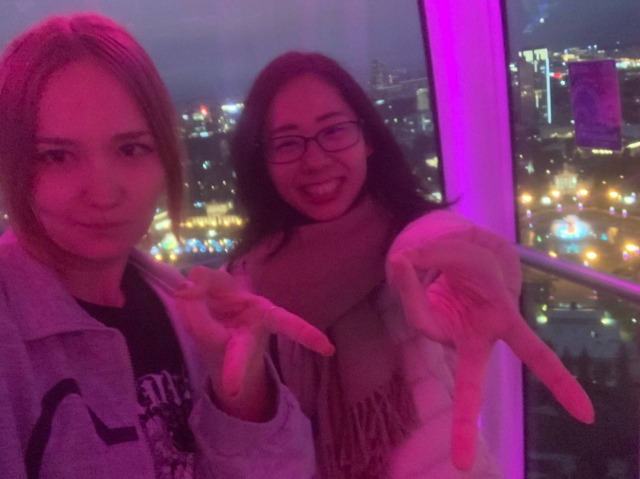
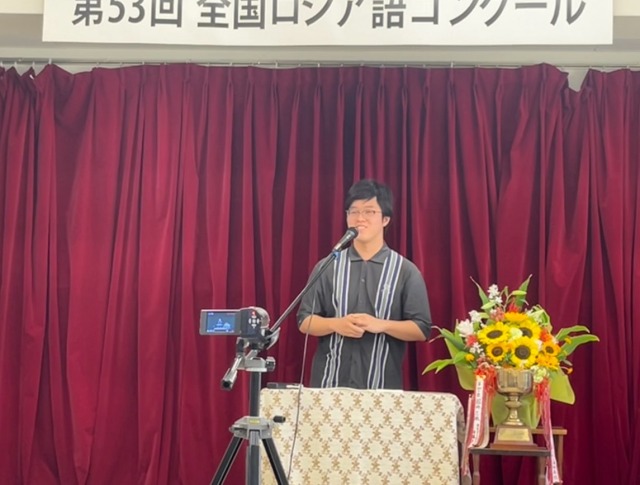
Please tell us what your speech was about at the competition.
Yanai spoke about his experience studying abroad in Kazakhstan for 10 months, and in his "Advice for People Going to Study Abroad" he talked about how knowing about one's own country's history and culture can help you open up to people at your host country, and how it is important to understand one's own country's culture even when learning a foreign language.
The general category is judged on a five-minute speech followed by a question-and-answer session, and since I had talked about cooking in my speech, the question I was asked was, "What is your recommended Kazakh dish?", so I introduced a home-cooked dish called kuyrdak, which is horse meat, innards, and vegetables stir-fried. It's a common dish that you can find in the prepared food section of a supermarket, but it's so delicious that when I was studying abroad, I would always order it if it was on the menu at a restaurant.
Miyauchi 's speech was based on the theme of "Beautiful Russia," and I summarized my dream of visiting Russia someday to see its magnificent church architecture and graceful ballet, as well as my hopes for the future of developing friendships in its rich natural environment.
"Beautiful Russia" is a memorable phrase that appears at the end of the film "203 Heights," which depicts the Russo-Japanese War. In the film, a teacher played by Aoi Teruhiko tells his students before going off to war, "It's no good thinking that all Russians are your enemy." Like this teacher, my starting point for this speech was my determination to cherish my friendship with Russians no matter what the situation. I was so nervous on stage that my mind went blank, but when I finished my speech and my tension eased, I saw people in the audience nodding and felt as if they had given me encouragement for my dream.
With Russia's invasion of Ukraine continuing, what do you think is the significance of learning Russian now?
Yanai: A language represents the people who use it. Even if you can communicate with a Russian speaker through English, I feel it's difficult to truly understand what they're trying to say unless you speak Russian. Regarding Russia's invasion of Ukraine, I don't intend to justify the war itself, but I do think the situation from Russia's perspective is different from that seen from Japan. In the future, I would like to work hard to help Russia build friendly relations with the world as a global citizen. To that end, I feel it is very important to study Russian thoroughly now.
Miyauchi: Like Yanai, I believe that learning a language has the power to increase the resolution of the other person and the situation. Russian words such as "katyusha" (headband) and "ikura" (salmon roe) have become part of Japanese, and some Ukrainian refugees require assistance in Russian. In fact, the Ministry of Justice and Tokyo Metropolitan Government have issued Russian-language versions of tools for refugees, but this fact is not widely recognized. Through learning Russian, I learned the importance of not being bound by stereotypes and instead being open-minded.
Please tell us your future goals.
Yanai: Next year, I plan to take the Level 1 Russian Language Proficiency Test. I would like to continue improving my Russian language skills and, in the future, use Russian to contribute to strengthening relations between Japan and Russia. Specifically, I believe there are many areas where Japanese companies can cooperate, such as in the development of Russia's abundant resources, and I would like to contribute to Russia deepening its ties with other Western countries through its cooperative relationship with Japan.
In terms of language studies at the Imperial Palace, I would like to take the Russian language proficiency test next year. Furthermore, to promote understanding and spread of Russian, I would like to organize casual social gatherings that bring together people with no prior experience of Russian and those who have studied in Russian-speaking countries. My Russian roots lie in my grandfather's hometown. I would like to visit it someday and report at his grave what the town was like and what kind of people lived there. Russian is a passport that connects me to my irreplaceable friends in Russia. To cherish this passport for the rest of my life, I would like to gain a variety of experiences and acquire the character to withstand the sway of the times and circumstances.
Please give a message to your juniors who are aiming to enter Soka University.
Yanai Soka University is a university with a rich international flavor, with deep ties to academic institutions around the world established by the founder, and a well-developed language learning environment. Furthermore, as long as you have enthusiasm, the teachers and staff will do their utmost to support you. In fact, my original desire to study abroad in Russia was not fulfilled due to the situation in Ukraine. However, I directly appealed to my professor, "I really want to study in a Russian-speaking country," and he arranged for me to study abroad in Kazakhstan, which made it a reality. I want to convey to everyone that Soka University is a place where you can achieve anything and grow, depending on how strongly you feel about your goals. We look forward to welcoming motivated students!
We are looking forward to welcoming motivated students! (We are looking forward to welcoming motivated students!)
Miyauchi Soka University is a humanistic university, and we will never deny you, no matter what your reality or past. I believe that accepting international students from Russia and Ukraine symbolizes Soka University's pursuit of international peace. I am once again reminded of the privileged environment in which I am studying. An intensive Russian language course will be launched next year, allowing students to combine their undergraduate studies with Russian language studies, expanding the opportunities for everyone to become unique. At Soka University, you are sure to find your place if you take action. I look forward to seeing you on campus. Please also come visit the Russian Center! Спасибо! Пока-пока! (Spasiba pakapaka / Thank you. See you soon!)
Related Links
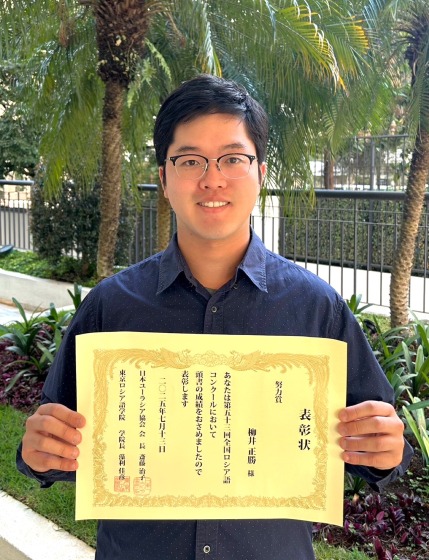
< Faculty of Letters Department of Human Studies 3 years>
Masakatsu Yanai
Yanai Masakatsu
- [Favorite saying]
- Where there's a will, there's a way
- [Personality]
- Cheerful, honest, and curious
- [hobby]
- Listening to classical music, playing piano and violin, reading, traveling
- [Books I've read recently]
- You can't understand Russia with your head / Kazuo Kobayashi
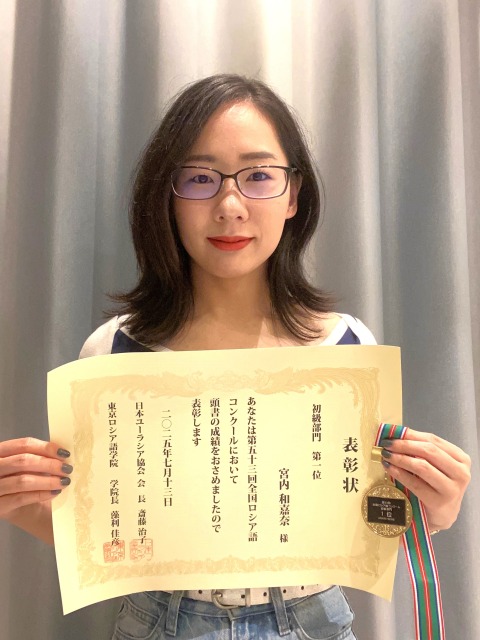
< Faculty of International Liberal Arts Department of International Liberal Arts 3 years>
Wakana Miyauchi
Miyauchi Wakana
- [Favorite saying]
- Your everyday life creates the world
- [Personality]
- Lazy
- [hobby]
- Watching movies, eating out
- [Books I've read recently]
- The Last Day of a Death Row Inmate / Victor Hugo
Pickup
Three initiatives to approach the SDGs from an economic perspective will be implemented within the university.
Collaborating with students at a local, cutting-edge educational institution to tackle local issues
Passing the difficult Tokyo Metropolitan Government employee exam: 4 years of growth fueled by setbacks

Learning Russian and building a bridge of peace in these difficult times
Halal food truck sales realized from multicultural coexistence exhibition