

Collaborating with students at a local, cutting-edge educational institution to tackle local issues
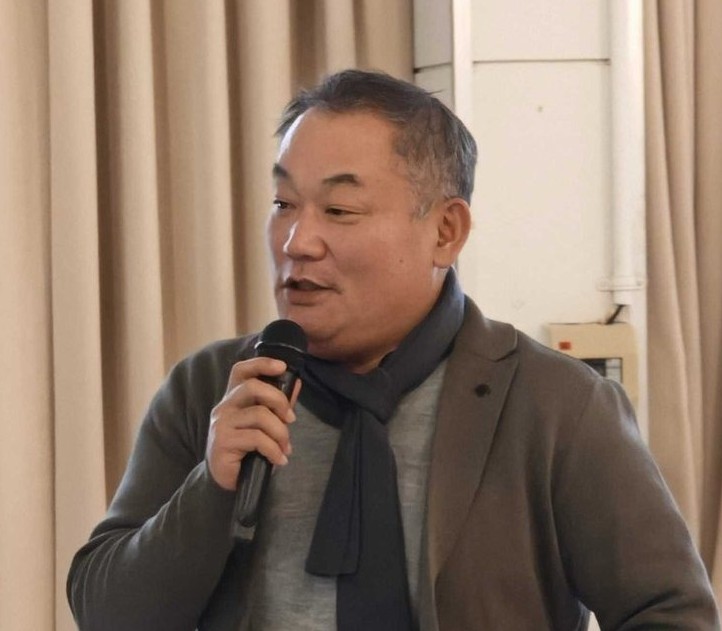
Takamichi Hamagami
Graduated from the Department of Sociology, Faculty of Letters, March 1991.
Fujitsu Limited, CEO's Office, DX Division
Takamichi Hamagami, who works for Fujitsu, is involved in a project to solve local issues with students at "Kamiyama Marugoto National College of Technology" in Kamiyama Town, Tokushima Prefecture. Kamiyama Town, a small town nestled in the mountains, is known as a leading area for regional revitalization, and Hamagami says that his attempt to cultivate entrepreneurs who can change society is a challenging experience for him. We asked him about his thoughts on working with talented young people, both as a business person and as an individual.
Please tell me about your current job.
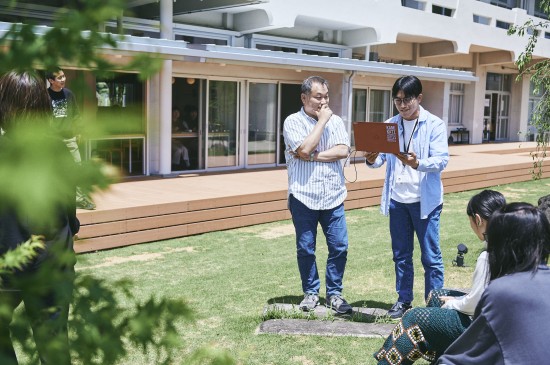
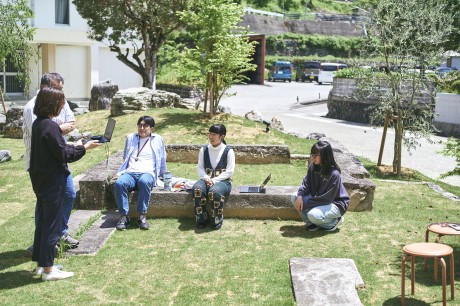
I am in charge of promoting collaboration at "Kamiyama Marugoto National College of Technology." Kamiyama Marugoto National College of Technology is a five-year private college of technology that opened in April 2023 in Kamiyama Town, Tokushima Prefecture. With "technology x design x entrepreneurship" as the foundation of its education, it is rooted in the Kamiyama area and aims to cultivate individuals who can move society—"people who can create things and make things happen." It is a private college of technology with 40-44 students per year, but thanks to contributions and donations from 11 companies (scholarship partner companies), including Fujitsu, students can study free of charge. Students are required to belong to one of the scholarship partner companies and participate in activities there. For example, in the 2025 academic year, first-year students were given the mission of understanding their affiliated company, and second-year students were given the mission of developing new businesses utilizing their affiliated company's resources. I support 3-4 Fujitsu scholarship students each from the first to third year (first cohort), who are sponsored by Fujitsu, and I also work to implement collaborative projects aimed at solving local issues by connecting students, employees, and local people.
What was theきっかけ (trigger/reason) for you to get involved with "Kamiyama All-in-One Technical College"?
In 2020, I was assigned to Tokushima as the branch manager and general manager of Fujitsu Tokushima. Since joining the company, I had been in the sales department at the Tokyo head office for a long time, and I had hoped that any transfers would be within the head office. However, I was asked to become a regional branch manager. The work in Tokushima was completely different in scale and the type of business required, which surprised me. Initially, I intended to return in one or two years, but I changed my mindset to "let's do something new here" and decided to challenge myself with something that only I could do at that time. I launched a project to address regional issues and revitalize the region. After that, there were several opportunities to return to the head office, but I wanted to complete the project I was working on, so three years passed. However, in the summer of that third year, our company introduced an internal posting system, and I was told, "You have to find your own transfer destination in your fourth year." This system allows employees to volunteer for positions advertised internally and go through the selection process. While I was starting to look for positions both inside and outside the company, an executive asked me, "Would you like to lead a collaborative project with Kamiyama Marugoto National College of Technology, which will open in 2023?" I was considering moving to Tokyo or Osaka, and I wondered if staying in Tokushima was the right decision. However, I decided that staying in Kamiyama would give me experiences I wouldn't have otherwise.
What kind of projects did you work on with the technical college students?
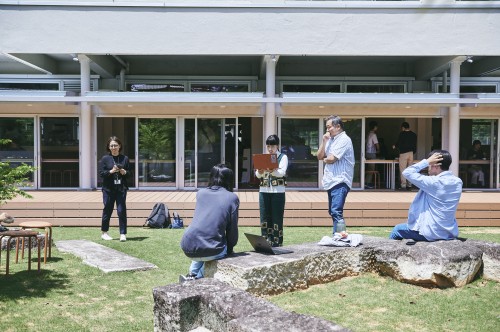
There are two representative projects. One of them is the Regional Transportation Issues Project. Like many rural areas in Japan, Kamiyama Town is experiencing an aging population, and many residents have difficulty with transportation. In 2023, the town-operated bus service, which had seen declining ridership, was discontinued, and a taxi subsidy service was started to ensure transportation for residents. However, it was discovered that the operating costs were five times higher than when the town-operated bus service was in operation. Students from the technical college also benefit from this service and, while finding it appealing, were concerned that it was not sustainable as it was putting a strain on the town's finances. It was at this time that we heard that Fujitsu's Mobility Business Division was interested in how technology could solve regional transportation problems, so we consulted with them. They responded that they wanted to support the mechanism of Kamiyama Town's taxi subsidy service. From there, the two parties formed a team and began working on interviews, data analysis, and hypothesis testing.
What specific methods have you considered to solve the regional transportation challenges?
Kamiyama Town has trip data that shows who took a taxi and where. We used this data to analyze it with AI. For example, if person A and person B, who arrives a little later, each take a taxi to the same hospital, the town incurs two separate charges. If these two people are in the same area and can be transported in one trip, the town's burden is halved. We simulated how costs could be reduced by optimizing ride-sharing and waiting times, and made recommendations to the town. In addition to this data analysis, the students also conducted interviews with residents and taxi companies. Subsequently, this initiative was selected for the Ministry of Land, Infrastructure, Transport and Tourism's Regional Transportation DX Promotion Project, and a demonstration experiment of hospital visit support was conducted at Tokushima Prefectural Central Hospital as the "Healthcare MaaS Implementation Project."
What is the other project?
This project aims to create a business model to address the labor shortage in agriculture. We worked on this project in collaboration with a consulting firm, one of our scholarship partner companies. Tokushima Prefecture accounts for 98% of Japan's sudachi production, but it faces the challenge of a declining number of farmers. To address this, approximately 20 employees from Tokyo and Osaka stayed in Kamiyama Town to help with the harvest alongside students, and then held discussions with farmers and town officials, all while experiencing the harvest and considering sustainable agriculture. This initiative was praised for its potential to solve agricultural problems by allowing urban business professionals to interact with students, experience agriculture, and create a system for continuous involvement in agriculture. As a result, a pilot project has been launched as a commissioned project by the prefecture.
This is truly putting into practice the learning philosophy of the technical college, which is to cultivate entrepreneurs.
Yes. Based on these experiences and lessons learned, four third-year students, who were part of the first cohort, formed a team called Tapaz and incorporated it as a company. Through workshops between students and companies and organizations in Tokushima, they are working to solve corporate problems and update the structure of society, transforming the power of young people into value. They have already received requests such as "effective use of vacant houses" and "thinking together about new forms of funerals."
What do you keep in mind when interacting with students?
We didn't want to impose our company's values on students, so when we started this collaborative project, we decided on four principles: ① Start with what students are interested in and want to do; ② Help students understand Fujitsu through communication with Fujitsu employees; ③ Create a co-learning environment that benefits not only students but also employees; and ④ Value students' free time, such as time for them to socialize with each other or simply relax.
One thing I consciously focused on was building a good relationship with the students. In 2024, I moved from Tokushima City to Kamiyama Town. As a fellow resident, I wanted to work on projects with the students on an equal footing. I believe that this approach resulted in the projects taking shape and ultimately led to the founding of Tapaz.
What did you personally learn through this project, Ms. Hamagami?
It's been about three years since we started the project. I've learned a lot from the students and Kamiyama Town, but the biggest takeaway has been the importance of building mutually beneficial relationships rather than one-way relationships between students and companies, students and society, and companies and society. And for that, the existence of "connectors" is indispensable. To "connect," it's important not to lead, and to move things forward while understanding and agreeing on each other's opinions, and I myself am consciously putting these into practice.
What are the attractions of working and living in Kamiyama, a place known as a "holy site for regional revitalization"?
Above all, the people of the town are kind, and the atmosphere is wonderful. They value chance encounters, which lead to new relationships. I think Kamiyama Town has a culture of accepting all kinds of people. Kamiyama Town is by no means a convenient place to live. That's precisely why I feel I've made up my mind to settle down here and work on projects. Currently, I go back to my home in Yokohama about twice a month, but I'm starting to feel that this two-base lifestyle is also good. I want to continue to cherish my connection with Kamiyama Town. There's also a possibility that I'll continue this two-base lifestyle even after retirement.
Furthermore, I experienced firsthand that industry-academia collaboration provides a learning opportunity not only for students but also for companies and their employees. In the future, I would like to understand this learning process and record it as evidence. While there is prior research that focuses on students, I would like to consider the effects on employee performance from a company's perspective and make recommendations.
What kind of student life did you have during your university years? Are there any experiences that are still relevant to you today?
I was a member of the American football team at Soka University for four years. I learned that what's important in team building is having a shared philosophy and building relationships among teammates, as this leads to good results. I think that experience has been useful in my work so far, and especially in the activities I'm currently doing with young people.
The time I spent with my university teammates was intense, and the bonds I formed with them are special. There were tough times, but the experience of working alongside my teammates is a valuable asset to me, and I believe my personality was shaped there. My father passed away when I was a sophomore, and I am still grateful to my teammates who supported me and to the founder who encouraged me. The students I interact with now are around the same age as I was back then. I want to interact with them in the same way the founder did, and I hope that my students will also build relationships based on mutual trust and support.
Finally, do you have a message for your juniors?
Life has its ups and downs. Even in the valleys, I want you to keep moving forward with hope. It is during difficult times that your true character is tested. That is why I want you to persevere through those times. I believe that your studies at Soka University will be a lifelong treasure for all of you. Let's forge a new era together!
<Faculty of Letters, Department of Sociology, Graduated March 1991>
Takamichi Hamagami
Takamichi Hamagami
- [Favorite saying]
- Better you, Better world.
- [Personality]
- Sincere and gentle
- [hobby]
- Reading, music
- [Books I've read recently]
- Conditions for Educational Reform / Naohiko Kanno
Pickup
Protecting African children from infectious diseases: The challenge of "Waka Waka Kenya"
Dedicated herself to the New York screening of a film depicting the atomic bombing of Nagasaki — a new career forged after raising children
To create a world where no one is left behind, we'll transform classroom knowledge into practical skills.
Drawing strength from his studies and encounters at Soka University, he joined Japan's largest general trading company.
We launched and published 'CanSta', a sustainable action platform created by students for students.