

Presentation Session: The most advanced Digital Transformation (DX) based on our Founder Ikeda-Sensei’s peace philosophy in AY2025
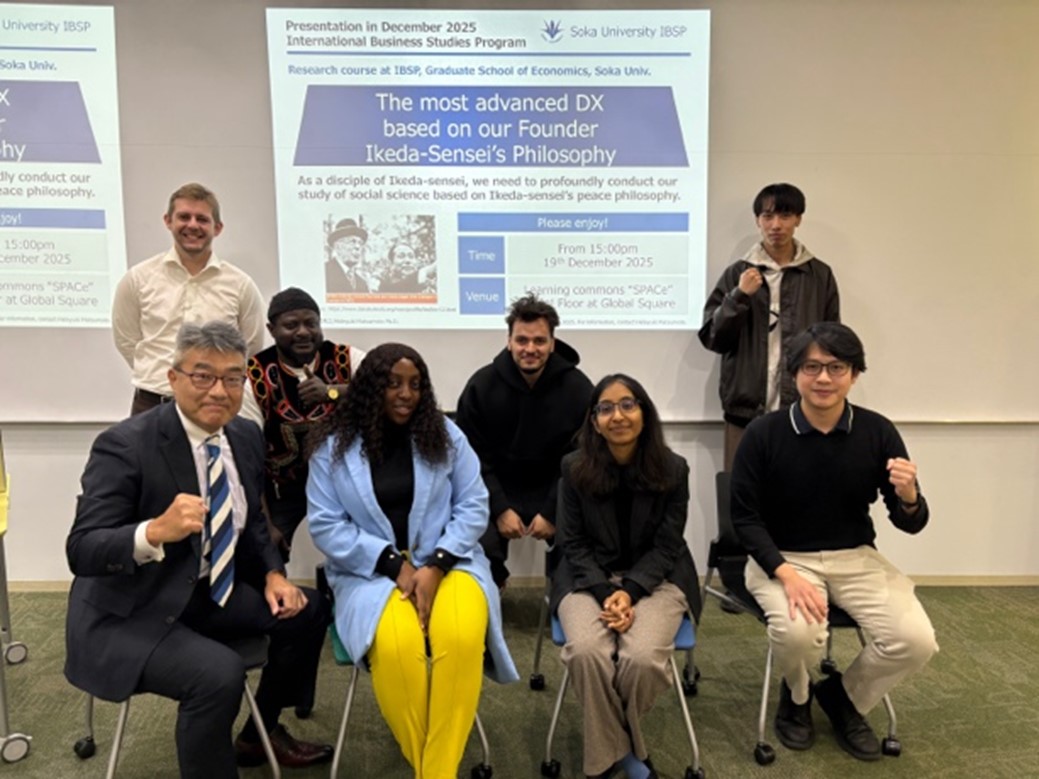
Soka University’s Graduate School of Economics, International Business Studies Program (IBSP), is progressing with its continuing research initiative on the most advanced Digital Transformation (DX) based on our Founder Ikeda-Sensei’s peace philosophy. This initiative, which began in AY2022, was launched to mark the significant milestone of the 50th Anniversary of the dialogue between Dr. Ikeda and British historian Dr. Arnold Toynbee.
Led by Dr. Hideyuki Matsumoto Ph.D., this phase of research integrates a historical review of the IT revolution with an adaptive, humanistic approach to technology. The AY2025 research team, comprising master’s degree students from India, France, Cameroon, Zambia, Thailand, and China, has synthesized the philosophical foundations of Cloud Computing, Robotics, Metaverse, Artificial Intelligence (AI), 5G/Mobile, and the Internet of Things (IoT) to propose a global framework for a peaceful, value-creative, and wealthy human society.
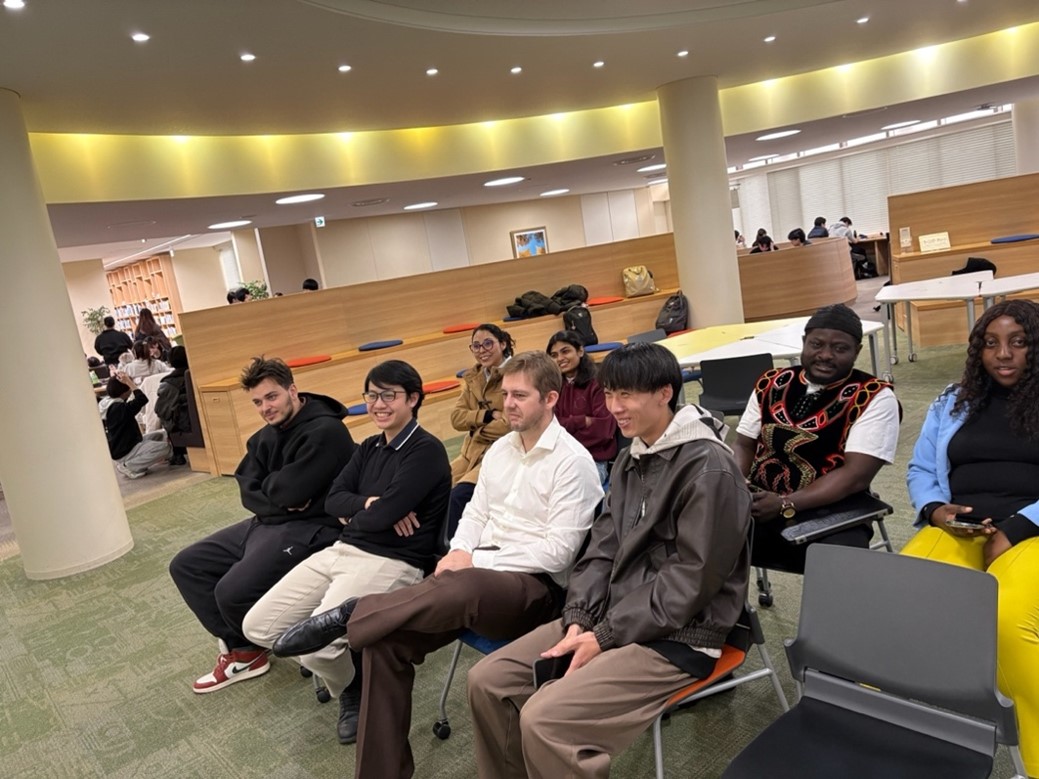
They presented outcome of their analysis through reviewing Ikeda-Sensei’s lectures delivered in overseas universities, conducting historical review of the IT revolution during and after the 1990’s, discovering the most advanced DX based on Ikeda-Sensei’s peace philosophy, and identifying further research at Global Square, Student Performance Acceleration Center (SPACe), 2nd Floor on 19th December 2025.
Research Team Details (AY2025)
The researchers presented their final findings in the following order:
- Yukti Bhaskar (India): Cloud Computing vs. Columbia University Lecture (1996)
- Simon Martin (France): Robotics vs. University of Macau Lecture (1991)
- Mukete Collins Ndo (Cameroon): Metaverse vs. UCLA Lecture (1974)
- Leah Mumba (Zambia): Artificial Intelligence (AI) vs. Rajiv Gandhi Institute Lecture (1997)
- Woravit Laotanu (Thailand): 5G/Mobile vs. Palermo University Lecture (2007)
- Xin Yuannian (China): Internet of Things (IoT) vs. East-West Center Lecture (1995)
To initiate the presentation, Dr. Hideyuki Matsumoto Ph.D. shared the academic foundations of this initiative, rooted in his doctoral research at Birkbeck college, University of London. His thesis, 'Cross-Cultural Comparison of Global Strategic Information Systems Management in the Multinational Investment Banking Industry,' provided the technical basis for analyzing global systems.
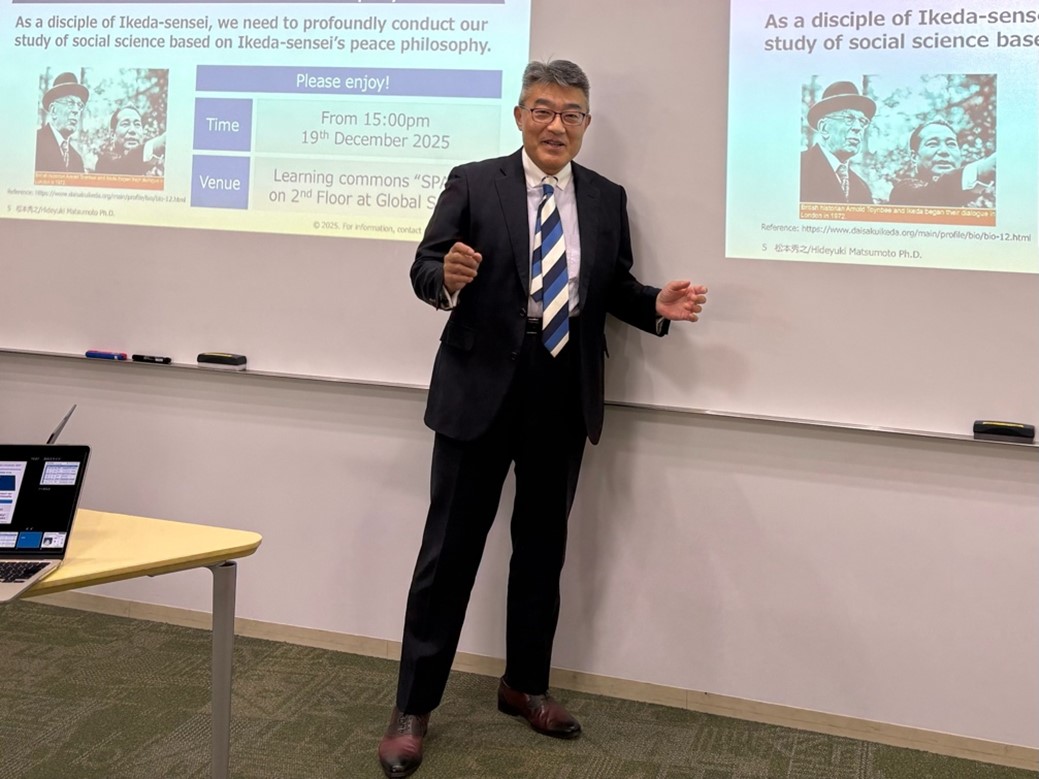
Dr. Matsumoto provided a historical and geographical overview of 32 significant lectures delivered by Founder Ikeda-Sensei at overseas universities between 1974 and 2007. Central to this framework is the Founder’s definition of globalization, inspired by the Toynbee-Ikeda dialogue, as the 'disappearance of distance.' Dr. Matsumoto emphasized that for social science research to truly contribute to a peaceful, value-creative, and wealthy human society, it must be anchored in these deep philosophical concepts. This synergy between advanced information systems and humanistic philosophy serves as the 'compass' for our AY2025 Digital Transformation (DX) analysis.
Yukti Bhaskar (India) – Cloud Computing
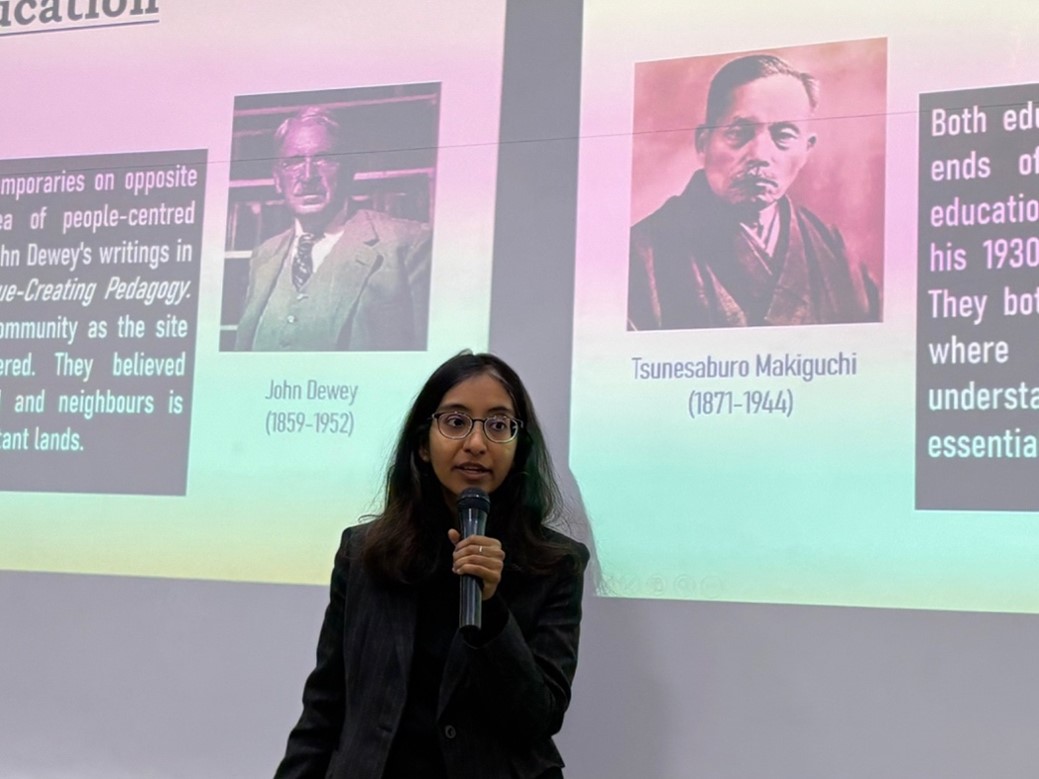
Yukti Bhaskar opened the session by sharing her motivation for joining the IBSP at Soka University. Coming from India, she was drawn to the university’s unique focus on global citizenship and humanistic values, believing it would foster both her professional expertise and personal character. As a master’s student, she is passionate about how digital infrastructure can create equitable economic growth. She defined Cloud Computing as the on-demand delivery of IT resources over the internet with pay-as-you-go pricing. Instead of buying and maintaining physical data centers, users access technology services, such as computing power and storage, from providers like AWS or Google. She detailed the three primary models: Infrastructure as a Service (IaaS), Platform as a Service (PaaS), and Software as a Service (SaaS). Thirdly, she analyzed this through Ikeda-Sensei’s 1996 lecture at Teachers College, Columbia University, "Thoughts on Education for Global Citizenship." She focused on the traits of wisdom, courage, and compassion. In conclusion, she argued that the Cloud should be a "Global Learning Commons" that bridges the educational divide. By ensuring technology remains subordinate to the dignity of the learner, she concluded that Cloud DX can become a value-creating platform for a truly interconnected and prosperous world.
Simon Martin (France) – Robotics
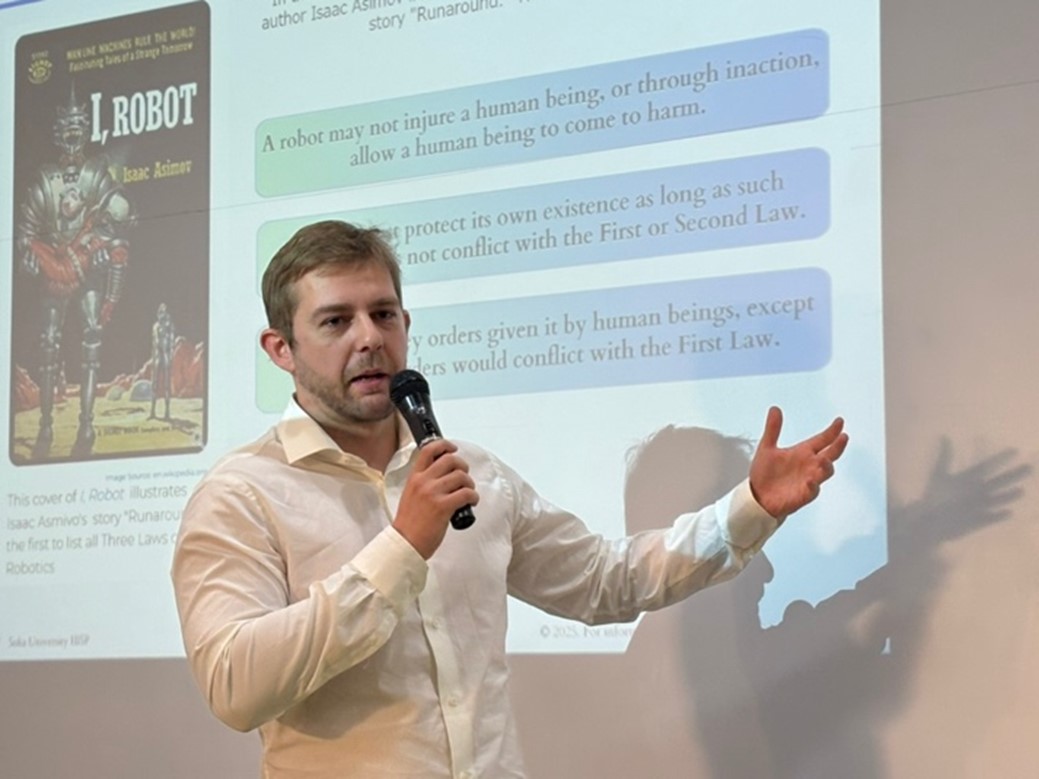
Simon Martin expressed that he chose Soka University because the humanistic approach to economics is vital for solving the modern challenges facing Europe. He introduced France’s history of "cohabitation" and its complex economic structure before providing a technical definition of Robotics. He explained that robotics is an interdisciplinary branch of computer science and engineering that involves the design, construction, operation, and use of autonomous machines. He distinguished between industrial robots used for manufacturing precision and service robots designed to interact with and assist human beings. Thirdly, he mapped these developments to the 1991 lecture at the University of Macau, "Arousing a New Global Awareness." Simon addressed the danger of "Cartesian" alienation, where technology creates a gap between humanity and the environment. He argued that as robots become more sophisticated, we must ensure they "arouse" our awareness of our shared humanity. In conclusion, he proposed that robotics must be developed to serve as a mirror for human self-discovery. By ensuring that automation is guided by humanistic ends, he concluded that robotics can contribute to a society where technology enhances the human spirit rather than replacing it.
Mukete Collins Ndo (Cameroon) – Metaverse
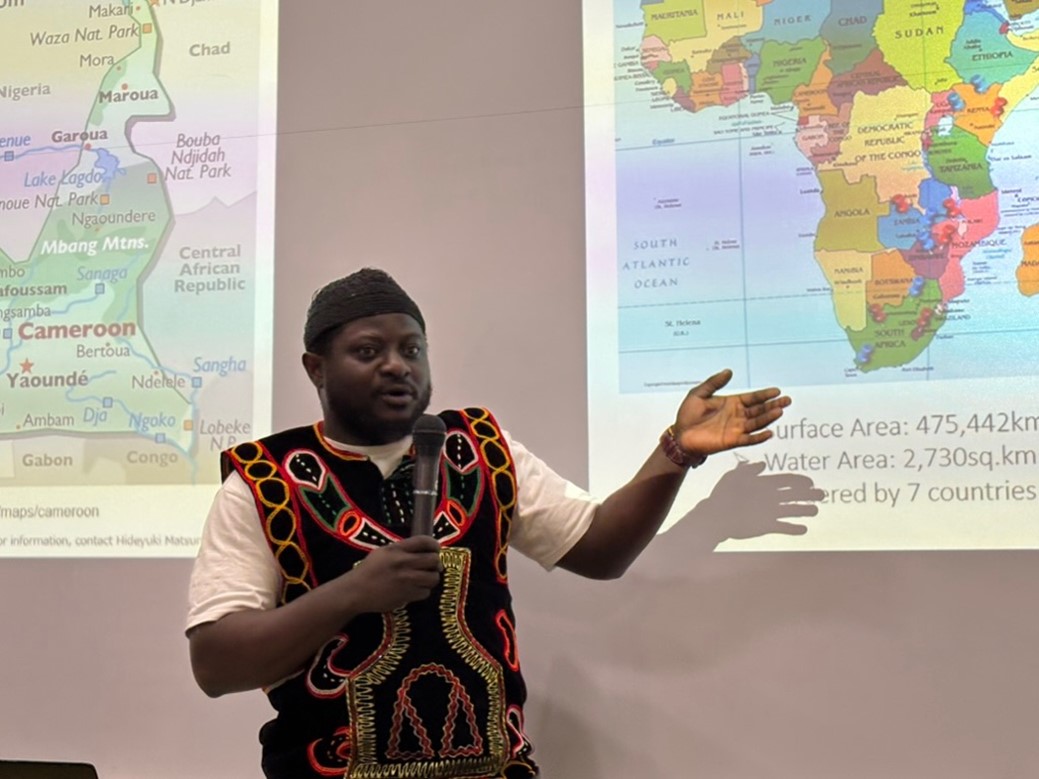
Mukete Collins Ndo shared that his journey to Soka University was driven by a mission to foster leadership that contributes to peace in Africa. He introduced Cameroon, often called "Africa in miniature," before defining the Metaverse. He described it as a collective virtual shared space, created by the convergence of virtually enhanced physical reality and physically persistent virtual space. He clarified the technical differences between Virtual Reality (VR), which provides full immersion; Augmented Reality (AR), which overlays digital data on the physical world; and Mixed Reality (MR), where digital and physical objects interact in real-time. Thirdly, he mapped this to the 1974 UCLA lecture, "Toward a Century of Humanity." He focused on the "Middle Way," arguing against the extremes of total digital escapism or complete technological rejection. In conclusion, he stated that the Metaverse should be used to provide safe virtual refuges for displaced persons and to facilitate global activism. By applying the "Middle Way," he concluded that the Metaverse can foster social inclusion and human dignity, turning a virtual space into a sanctuary for those marginalized in the physical world.
Leah Mumba (Zambia) – Artificial Intelligence (AI)
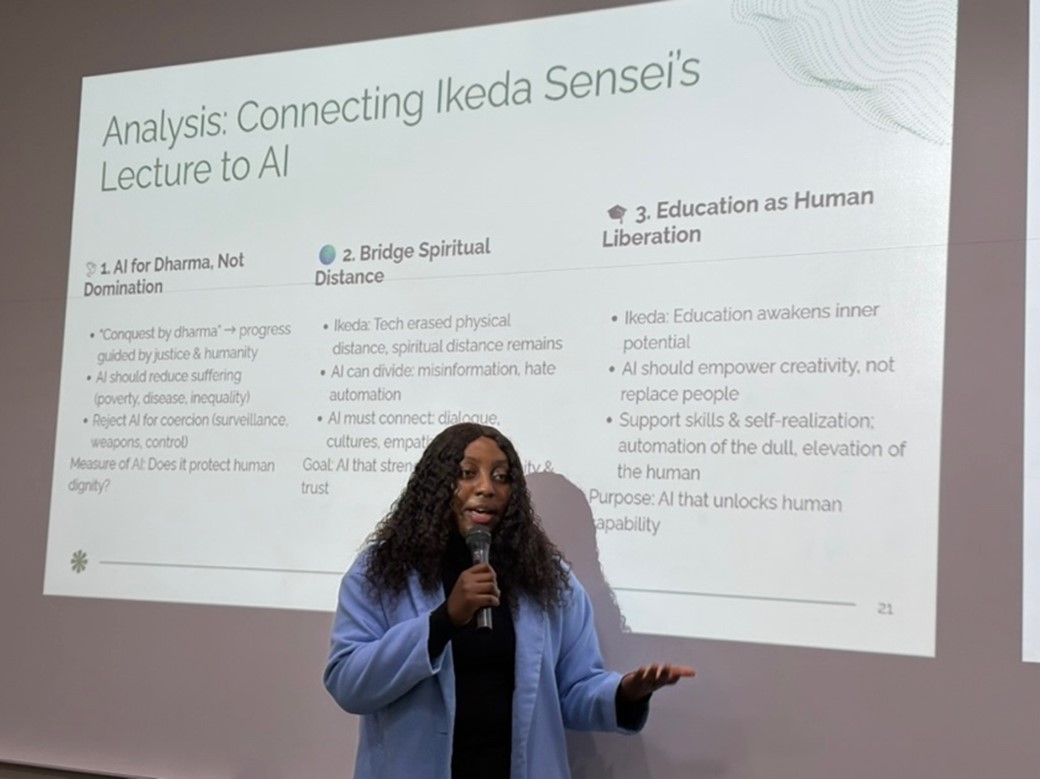
Leah Mumba shared that she chose Soka University because of its multicultural community and its commitment to humanistic education, which reflects the Zambian spirit of Ubuntu ("I am because we are"). She defined Artificial Intelligence (AI) as the simulation of human intelligence by machines, particularly computer systems, which includes learning, reasoning, and self-correction. She explained the difference between "Narrow AI," which performs specific tasks like facial recognition, and the broader potential of "Generative AI." Thirdly, Leah analyzed AI through the 1997 Rajiv Gandhi Institute lecture, "A New Humanism for the Coming Century." She noted that while AI can erase physical distance, it often fails to bridge "spiritual distance." Following the Founder's guidance, she argued that AI progress must be "guided by justice" (dharma) to reduce human suffering such as poverty and disease. In conclusion, she stated that AI should be a tool for Human Liberation, empowering creativity rather than dominating the human spirit. She concluded that when AI is used to unlock human capability and bridge cultural empathy, it serves as a true instrument for a value-creative society.
Woravit Laotanu (Thailand) – 5G/Mobile
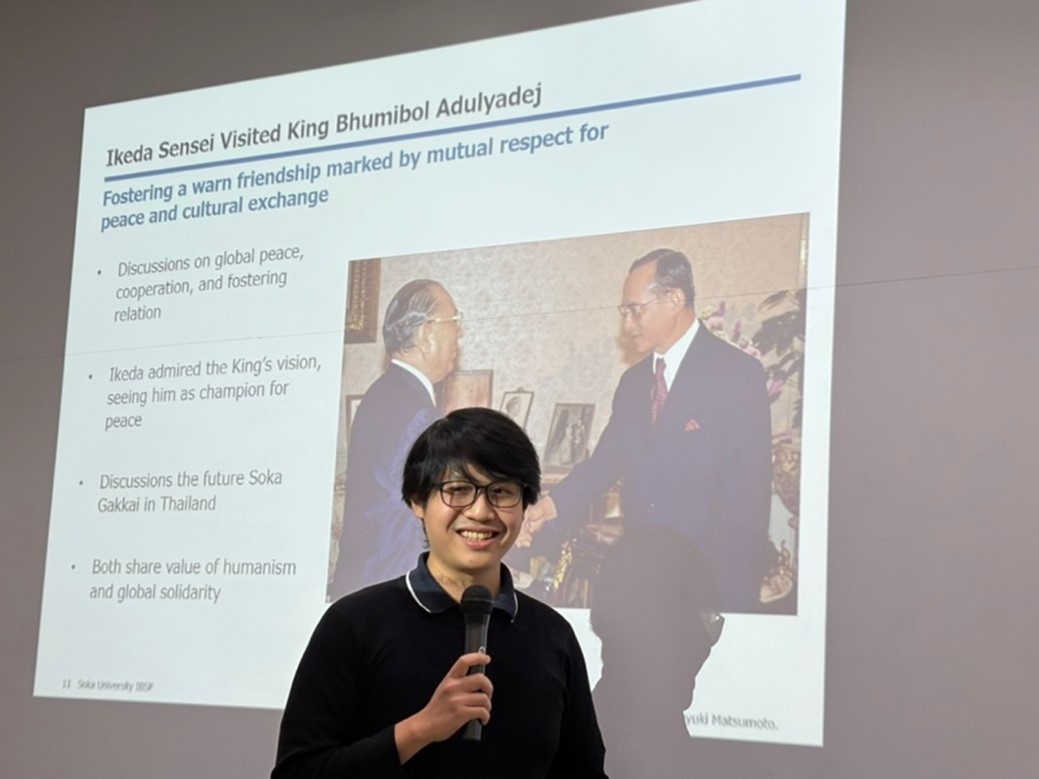
Woravit Laotanu expressed that his goal at Soka University was to learn how to combine technological innovation with ethical leadership. He introduced Thailand’s role as a regional economic crossroads before defining 5G Technology. He explained that 5G is the fifth generation of cellular networks, offering up to 100 times faster speeds than 4G, ultra-low latency, and the capacity to connect millions of devices simultaneously. He highlighted how 5G acts as the essential infrastructure for the "Internet of Everything." Thirdly, he mapped this to the 2007 University of Palermo lecture, "From the Crossroads of Civilization." Woravit argued that while 5G eliminates physical barriers, it requires "Open Dialogue" to ensure this connectivity leads to peace. In conclusion, he stated that mobile DX must facilitate a "Parliament of Humanity" where diverse voices are heard instantly across borders. He concluded that 5G’s ultimate value lies in its power to foster a culture of dialogue and mutual understanding in a hyper-connected global society.
Xin Yuannian (China) – Internet of Things (IoT)
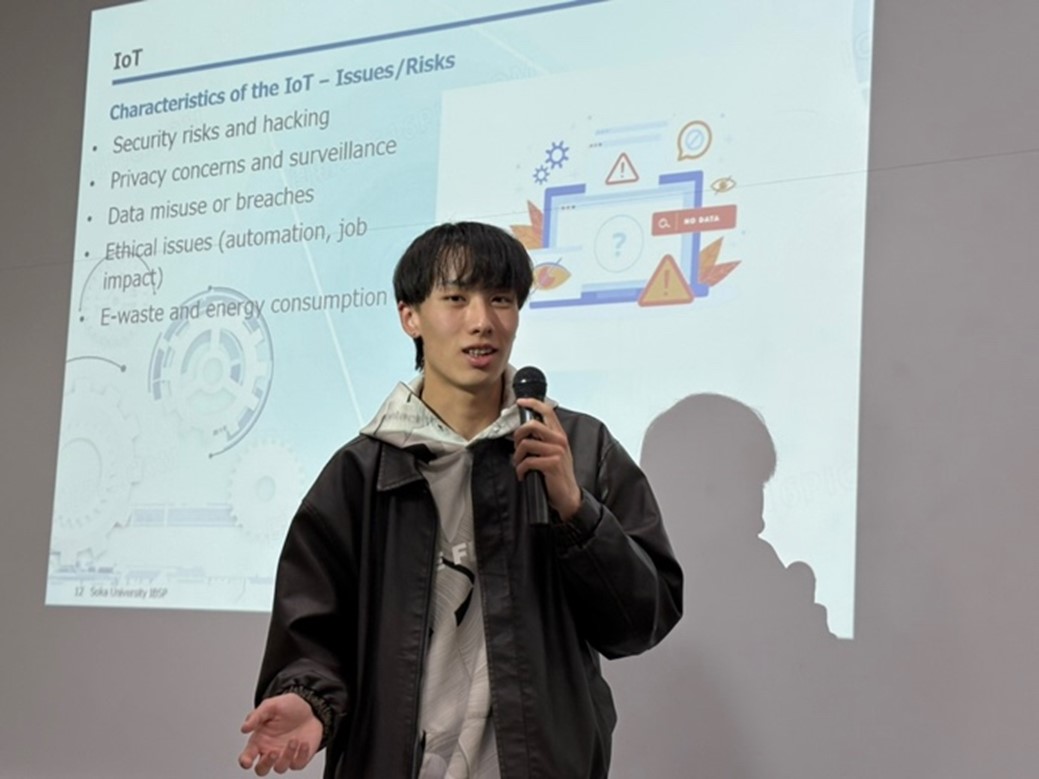
Xin Yuannian concluded the presentations by expressing his commitment to the IBSP mission of creating value for humanity. He introduced China’s rapid digital transformation before defining the Internet of Things (IoT). He explained that IoT is a network of physical objects embedded with sensors and software for the purpose of connecting and exchanging data with other devices over the internet. He highlighted the shift toward the "Intelligence of Things," where data-driven insights allow for autonomous improvements in energy use and logistics. Thirdly, he analyzed IoT through the 1995 East-West Center lecture, "Peace and Human Sovereignty." He argued for a shift from "National Sovereignty," which causes data silos and competition, to "Human Sovereignty." In conclusion, he proposed that IoT should be used to build global trust through transparent data sharing on environmental and social issues. He concluded that by utilizing IoT to serve the collective interests of humanity—such as climate monitoring and disaster prevention—we can move toward a sustainable and peaceful global society.
Summary of the Synthesis
These six presentations provide a comprehensive map of the "Most Advanced DX." By rooting each technology in the philosophical soil of the Founder's overseas lectures, the AY2025 team has demonstrated that technological progress is only meaningful when it serves the cause of human dignity and peace.