



Courtesy visit from Sofia university in Bulgaria and A Brief Review of the Complimentary Book from Assistant Prof. Tsvetomira Hristova Ivanova, PhD
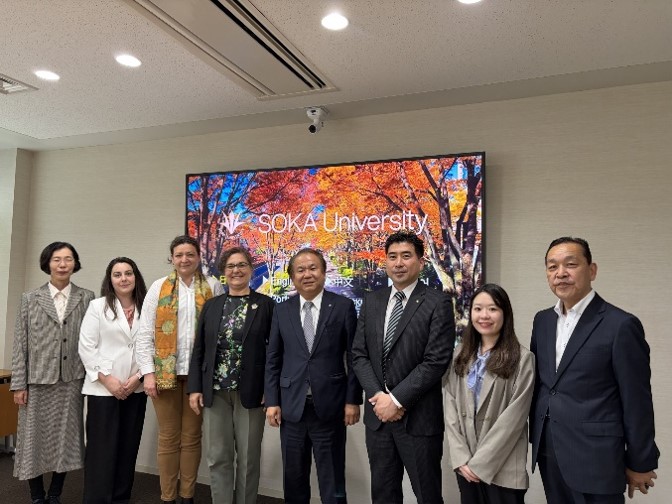
On May 12, Soka University welcomed the delegation from Sofia University in Bulgaria and discussed future collaboration between the two institutions, with the attendance of our new university President Mika Suzuki. Prof. Naoki Kuriyama, Dean of Graduate School of Economics discussed future cooperation in IBSP education and research.
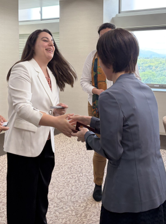
Among them, Prof. Ivanova (in the photo shaking hands with President Suzuki) gave Soka University her recent publication (published in Bulgaria and written in the Cyrillic Bulgarian language) on the topic of the re-generation of a Japanese remote village.
Here is the review article translated by Prof. Lim Tai Wei, Assistant Dean of Graduate School of Economics. Prof. Ivanova will come to stay for her research and lecture at Soka using Erasmus funds next year.
Translated Title: Current Actors and Policies in Regional Revival and Restoration:
A Case Study of Ogata Village by Tsvetomira Ivanova (2026)
Ogata village is a traditional village in Japan that had a long history of adaptations to the landscape and water resources of the land. But its restoration and revival were a carefully planned and well-designed process to maximize its agricultural output. But, even with its engineered success, it began to encounter the challenges of the aging population in its periphery, affecting its manpower availability. Demographic depopulation is now affecting its economic and agricultural revival. Demographic decline is the result of a complex coterie of factors.
Economic revival involves local branding and fresh injection of entrepreneurial skills. The objective of sustainable development is also very important. The study of this village can also shed light on the common challenges that rural areas and village face in Japan. Ethnographic lens and observations of the case study can also provide a glimpse into the community developments and activities as well.
The actor network theory utilized in the reader helped readers understand the relationships between state institutions and local actors/communities in translating policies into actual implementations. The social aspect of this process focuses on the ties that binds the community, which are so resilient that they resist community aging through the use of technologies, institutions and the digitalization. These non-human factors are crucial in bring about long-term structural changes to the village. The digitalization processes also modify the daily lifestyles and work patterns of local residents.
Ultimately, the state-engineered success in the Ogata village is an exercise in the rationalization of land resources. The writer argues that the case study cannot be evaluated solely based on a binary between modernity and traditionalism. The author suggest that technologies and infrastructure alone cannot account for Ogata Village development but that mutual support networks and community bonds were just as important.
Because of this, the Ogata village case study and experiment may be an example of not measuring success in terms of economic and output growth but as an alternative to developing rural spaces without excessive dependence on economic indicators for gauging success.
The author ends off with a humanistic view of the village. That it is a human-centered community based on community bonds with a desire to live with each other in harmony through self-help initiatives. That it is based on human emotions and love for each other. And that the village development is not static but adapts to the environment, time and space.
(Google Translate was used for translation purposes for this review)